Abstract
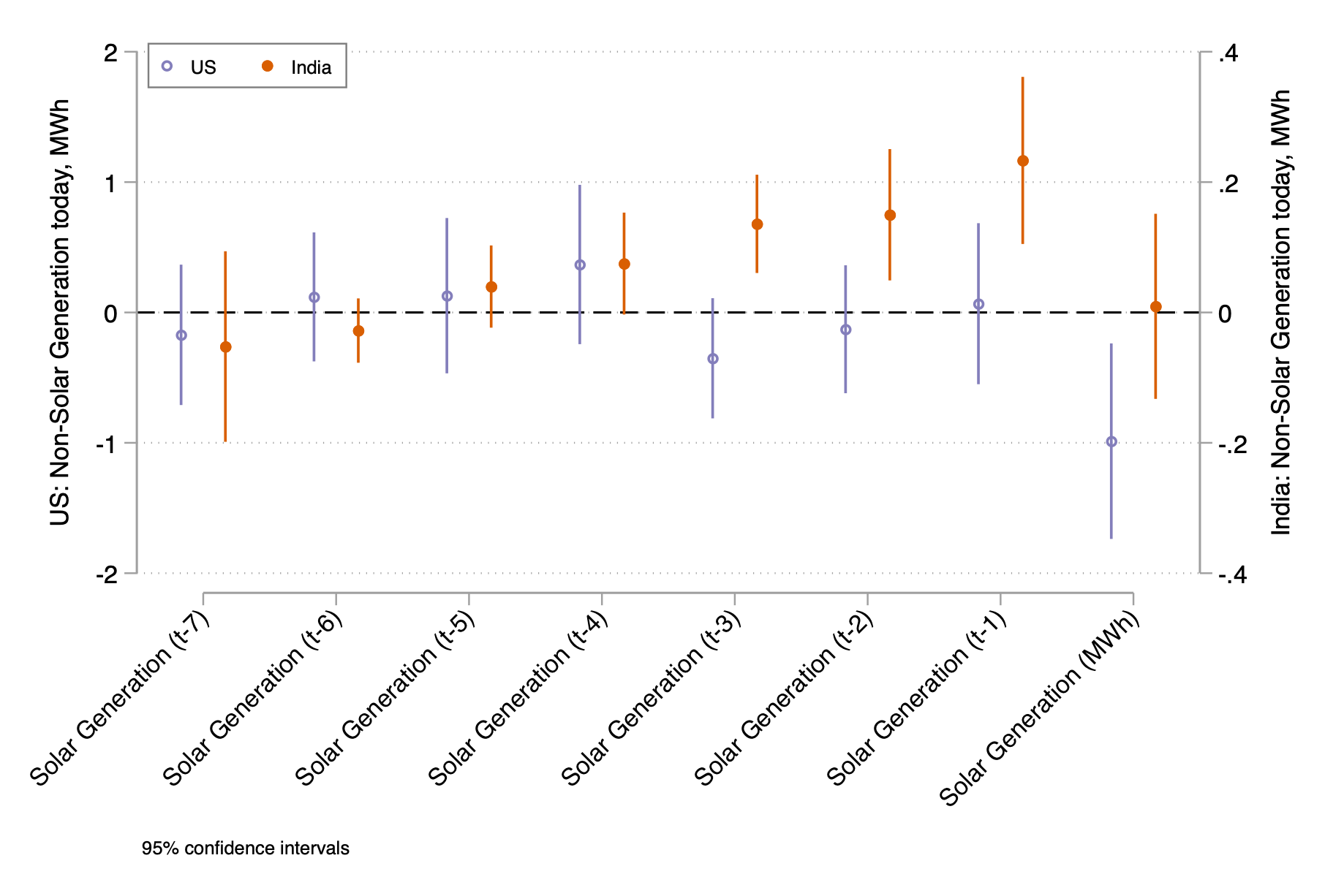
Conventional wisdom suggests that solar generation reduces emissions by displacing fossil fuels but, because of its variability, might undermine electricity reliability. Using plausibly exogenous spatial and temporal variation in solar plants’ exposure to the sun’s energy, I find that while this holds for the US, where solar displaces nonsolar generation one-for-one, in India, solar generation instead expands energy supply and eases shortages that cause power outages. Solar does not contemporaneously displace nonsolar generation one-for-one in India, and solar generation over the past week increases current nonsolar generation and, in turn, total generation. This result is driven by the accumulation of coal stocks at power plants in India, where coal shortages drive power outages. When solar fulfills a greater share of demand, power plants need less coal, which allows residual stocks to build up. These stocks are drawn down in subsequent days to increase generation. I test whether this increase in generation translates to improvements in reliability by applying machine learning techniques: I predict power outages using daily satellite night-time lights data and find that solar generation reduces the share of pixels under outage by 9%. Hence, in India, solar delivers a low-carbon energy expansion, not an energy transition: it improves reliability but does not necessarily cut emissions from existing fossil fuel sources.
Figure 7: Impacts of Solar Generation on Nonsolar Generation in India and the US
Citation
Siddhi Doshi. 2025. “Sunny Days, Bright Nights: How Solar Power Affects Electricity Reliability in India” Working Paper.